

Texas Electricity Shopping 101: How to Compare Plans and Read an EFL
Last updated: September 3, 2026
Shopping for electricity in Texas involves more than selecting the lowest advertised rate. The right plan for a household depends on how much electricity the home uses, how the rate is calculated, the contract length, delivery charges, recurring fees and whether the plan includes bill credits or time-of-use pricing.
The Electricity Facts Label, commonly called an EFL, provides the information customers need to make a meaningful comparison. Before enrolling, shoppers should use their actual electricity usage, read the EFL and estimate the complete monthly cost of each plan.
This guide explains how Texas electricity shopping works, where to research plans, how to read an EFL and which details deserve a closer look.
How Does Electricity Shopping Work in Texas?
Customers in competitive areas of Texas can choose a Retail Electric Provider, or REP. The REP offers the electricity plan, enrolls the customer, manages the account, sends the bill and provides customer support.
The local Transmission and Distribution Utility, or TDU, continues to deliver electricity to the property. The TDU owns and maintains the poles, wires and electric meter, reads the meter and restores power outages.
Changing Retail Electric Providers does not normally change the local utility or require new wiring. The service address determines the TDU, while the customer selects the REP and electricity plan.
If you are unsure whether Southern Federal Power serves your address, read What Areas Does Southern Federal Power Serve?
Where Should Texans Research Electricity Plans?
A good starting point is PowerToChoose.org, the official electricity-shopping website of the Public Utility Commission of Texas. Customers can enter a ZIP code, select the correct utility territory and compare plans posted by certified Retail Electric Providers.
Customers should also visit the provider’s official website. A provider may offer plans directly that are not displayed through every third-party marketplace.
Commercial electricity comparison websites can offer useful filters, calculators and enrollment assistance. However, their marketplaces may be limited to participating providers or business partners. Customers should not assume that one commercial website displays every provider or every plan available at an address.
A thorough shopping process uses several sources:
- Begin with PowerToChoose.org.
- Check the Retail Electric Provider’s official website.
- Review the EFL for every plan under consideration.
- Calculate the estimated bill using the home’s actual usage.
- Verify the contract terms before enrolling.
Start With Your Actual Electricity Usage
The best electricity plan for one household may be expensive for another. Usage is one of the most important reasons.
Before comparing plans, collect 12 months of electricity usage when possible. This information may appear on previous bills or in the current provider’s online account. Using a full year helps account for seasonal differences, particularly summer air-conditioning use and winter heating.
Record the number of kilowatt-hours, or kWh, used during each billing period. Do not rely only on the size of the home or the usage of a neighbor. Insulation, appliances, thermostat settings, occupancy and weather can produce very different electricity needs in similar homes.
If the address is new and no history is available, estimate cautiously and examine what the plan would cost across several usage levels.
What Is an Electricity Facts Label?
An Electricity Facts Label is a standardized plan disclosure for Texas retail electricity customers. It works much like a nutrition label by placing important pricing and contract information in one document.
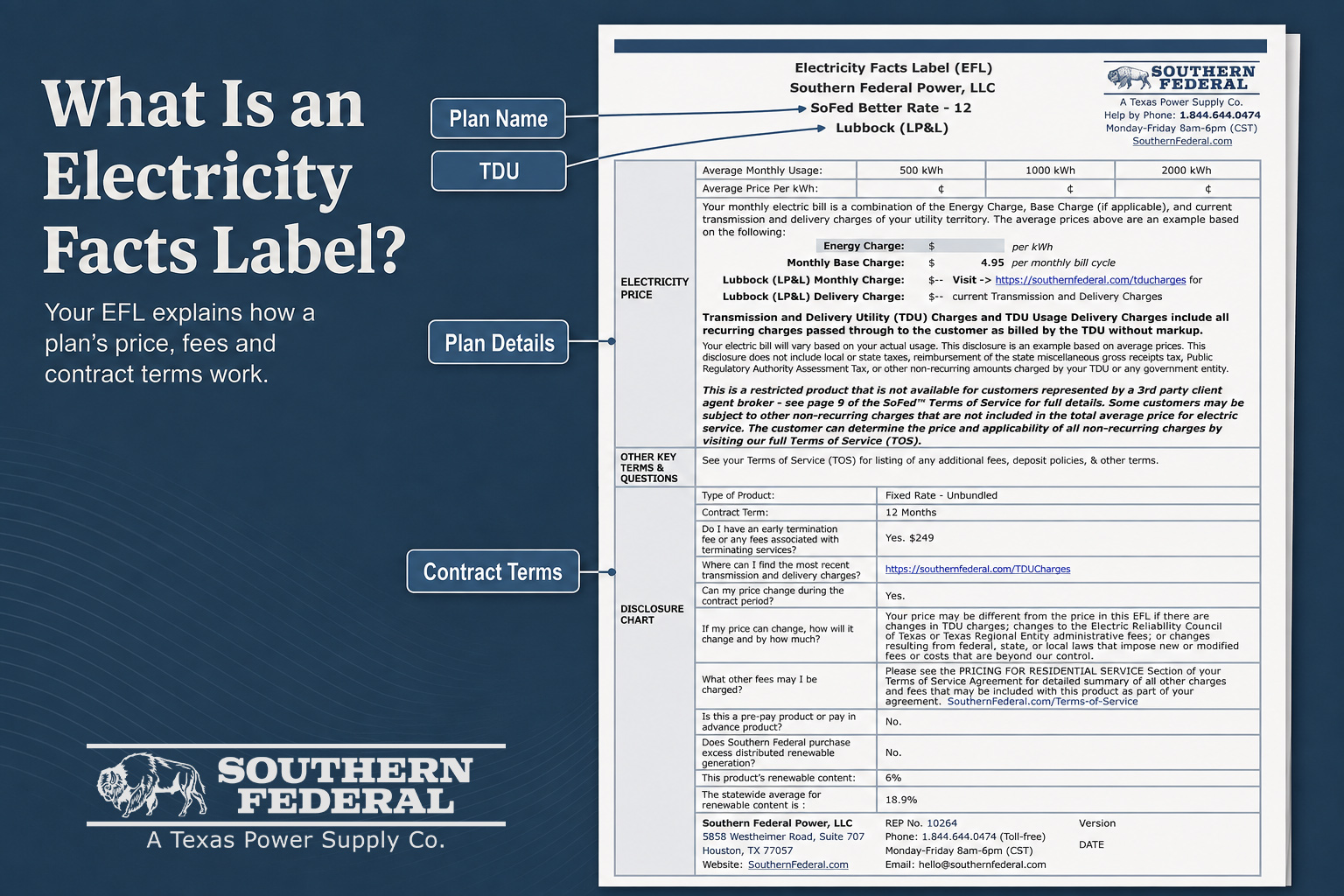
An EFL generally identifies:
- The average price at 500, 1,000 and 2,000 kWh
- The energy charge
- Any base charge
- TDU delivery charges included in the calculation
- Bill credits or usage-based charges
- Whether the price is fixed or variable
- The contract length
- The early termination fee
- Renewable energy content
- The plan name and provider
The EFL should be reviewed together with the Terms of Service and Your Rights as a Customer document. The EFL summarizes the plan’s pricing, while the other documents contain additional contractual and consumer-protection information.
Why Does the EFL Show Prices at 500, 1,000 and 2,000 kWh?
Texas EFLs show an average price per kWh at three standard monthly usage levels. These examples help customers see how the plan behaves as consumption changes.
The displayed figures are not three different energy rates. Each figure represents the estimated total price at that usage level divided by the number of kilowatt-hours used.
For example, a plan might look inexpensive at 1,000 kWh because a bill credit begins at that threshold. If the home uses 950 kWh, the customer may miss the credit and pay a much higher effective price.
Customers should compare all three EFL examples and then calculate costs at their own typical usage. A plan with similar average prices across 500, 1,000 and 2,000 kWh generally behaves more consistently than one with a sharp drop at a single threshold.
What Is the Energy Charge?
The energy charge is the amount charged by the Retail Electric Provider for each kilowatt-hour of electricity used. It is usually expressed in cents per kWh.
If a plan has an energy charge of 10 cents per kWh and a customer uses 1,000 kWh, the energy portion of the bill would be $100 before adding base charges, TDU charges, taxes or adjustments.
The energy charge should not be confused with the average price displayed at the top of the EFL. The average price can include several other charges and credits.
What Are TDU Delivery Charges?
Transmission and Distribution Utility charges pay for delivering electricity through the local grid. They support the poles, wires, substations, meters and other infrastructure used to move electricity to the service address.
TDU charges commonly include:
- A fixed monthly delivery charge
- A delivery charge based on the number of kilowatt-hours used
These charges vary by utility territory and can change after regulatory approval. Southern Federal Power does not determine the TDU charges.
Customers can review current Texas transmission and delivery charges for CenterPoint Energy, Oncor, AEP Texas North, AEP Texas Central, Texas-New Mexico Power and Lubbock Power & Light.
When comparing plans in the same utility territory, make sure the EFLs use the same current TDU charges. A recently updated EFL may show a different average price than an older document because the utility’s delivery rates changed.
Why Does an Electricity Provider Charge a Base Charge?
A base charge is a fixed monthly amount included in some electricity plans. It does not change with the number of kilowatt-hours used.
When a Southern Federal Power plan includes a base charge, the charge helps support the fixed cost of maintaining and servicing the customer’s account. These costs can include:
- Customer-care representatives
- Billing and account-management systems
- Payment processing
- Customer notices and communications
- Data and transaction processing
- Regulatory and compliance requirements
These services must be maintained whether a customer uses 500 kWh or 2,000 kWh during the month.
A plan with a base charge is not automatically more expensive than a plan without one. A plan may combine a modest base charge with a lower energy charge. The only reliable comparison is the complete estimated bill at the customer’s expected usage.
Customers should also distinguish a provider base charge from the TDU’s fixed monthly delivery charge. Both may appear in the EFL calculation, but they are charged for different purposes.
How Do I Estimate the Complete Monthly Bill?
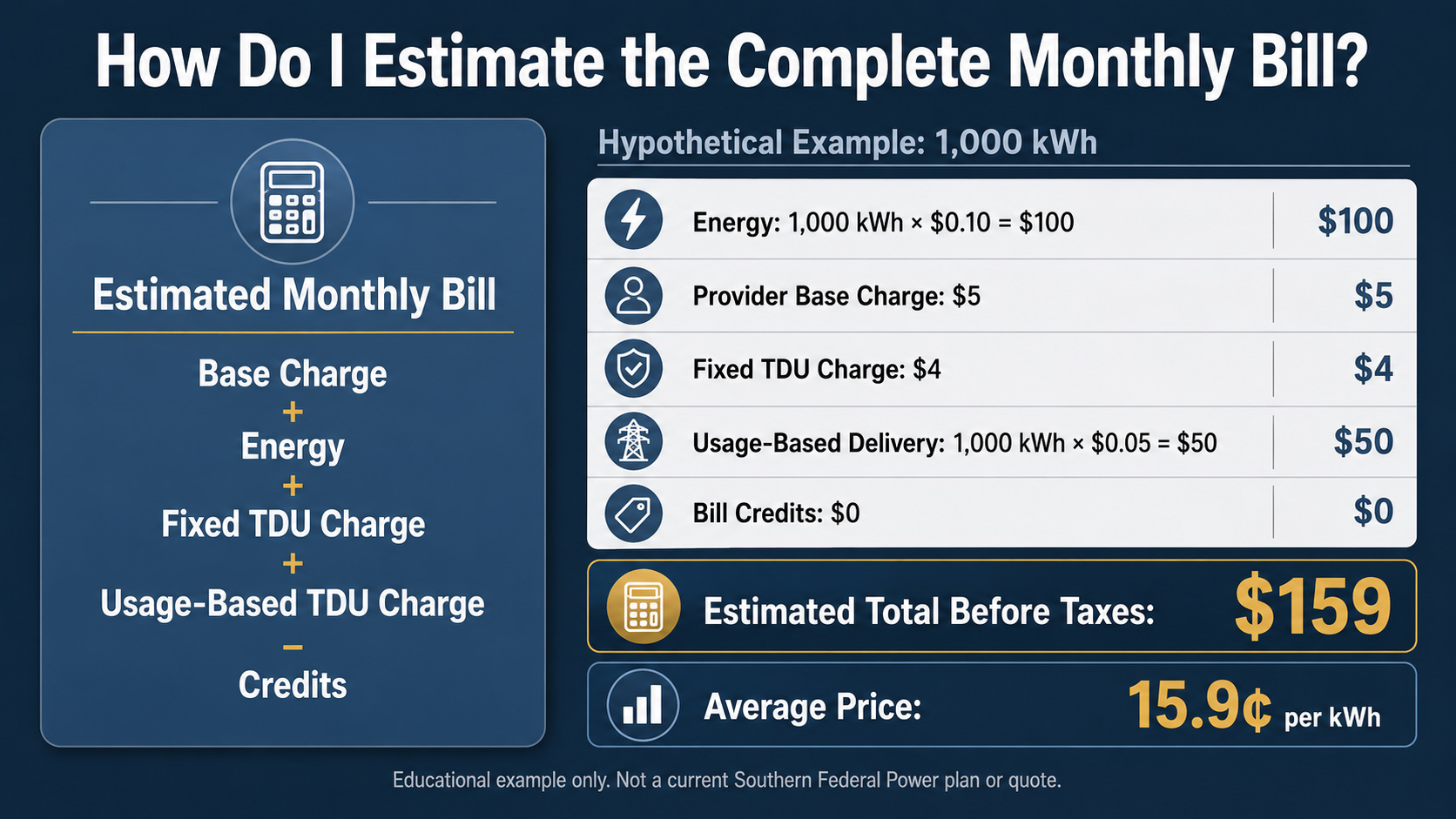
A simplified calculation is:
Estimated monthly bill = provider base charge + energy charges + fixed TDU charge + usage-based TDU charges − applicable credits
Taxes and other charges may also apply.
Consider this hypothetical example for educational purposes only:
- Monthly usage: 1,000 kWh
- Energy charge: 10 cents per kWh
- Provider base charge: $5
- Fixed TDU charge: $4
- Usage-based TDU charge: 5 cents per kWh
- Bill credits: None
The calculation would be:
- Energy: 1,000 kWh × $0.10 = $100
- Provider base charge: $5
- Fixed TDU charge: $4
- Usage-based delivery: 1,000 kWh × $0.05 = $50
- Estimated total before taxes: $159
The estimated average price would be 15.9 cents per kWh because $159 divided by 1,000 kWh equals $0.159 per kWh.
This example is not a current Southern Federal Power plan or quote. Actual pricing must be calculated from the EFL for the specific plan and service address.
How Do Bill-Credit Plans Work?
A bill-credit plan provides a credit when the customer satisfies a stated usage condition. For example, a plan might award a credit when usage reaches at least 1,000 kWh during the billing period.
Bill credits can lower costs for households that consistently meet the requirement. They can also create a sharp increase in the effective price when usage falls just below the threshold.
Before choosing a bill-credit plan, ask:
- At what usage does the credit begin?
- Is there an upper usage limit?
- How much is the credit?
- How often did my household meet that condition last year?
- What would my bill be if I missed the credit?
Calculate the plan both with and without the credit. A low advertised average price may depend on receiving that credit every month.
What Is a Minimum-Usage Fee?
A minimum-usage fee is a charge that applies when consumption falls below a specified level. It is different from a base charge that applies every month.
Minimum-usage fees can make a plan more expensive for apartments, energy-efficient homes and households with low seasonal usage. The EFL should identify the threshold and fee.
Customers should examine their lowest-usage months before selecting a plan with a minimum-usage requirement.
What Are Free Nights and Time-of-Use Plans?
Time-of-use plans charge different rates depending on when electricity is consumed. Some offer a discounted or zero energy charge during designated nights, weekends or other periods.
The word “free” may apply only to the provider’s energy charge during the stated period. TDU delivery charges and other fees may still apply. The rate outside the discounted period can also be higher than a conventional plan.
A time-of-use plan may work well for a household that can shift substantial consumption into the discounted hours. Before enrolling, estimate how much electricity is actually used during each pricing period.
What Is the Difference Between Fixed and Variable Electricity Rates?
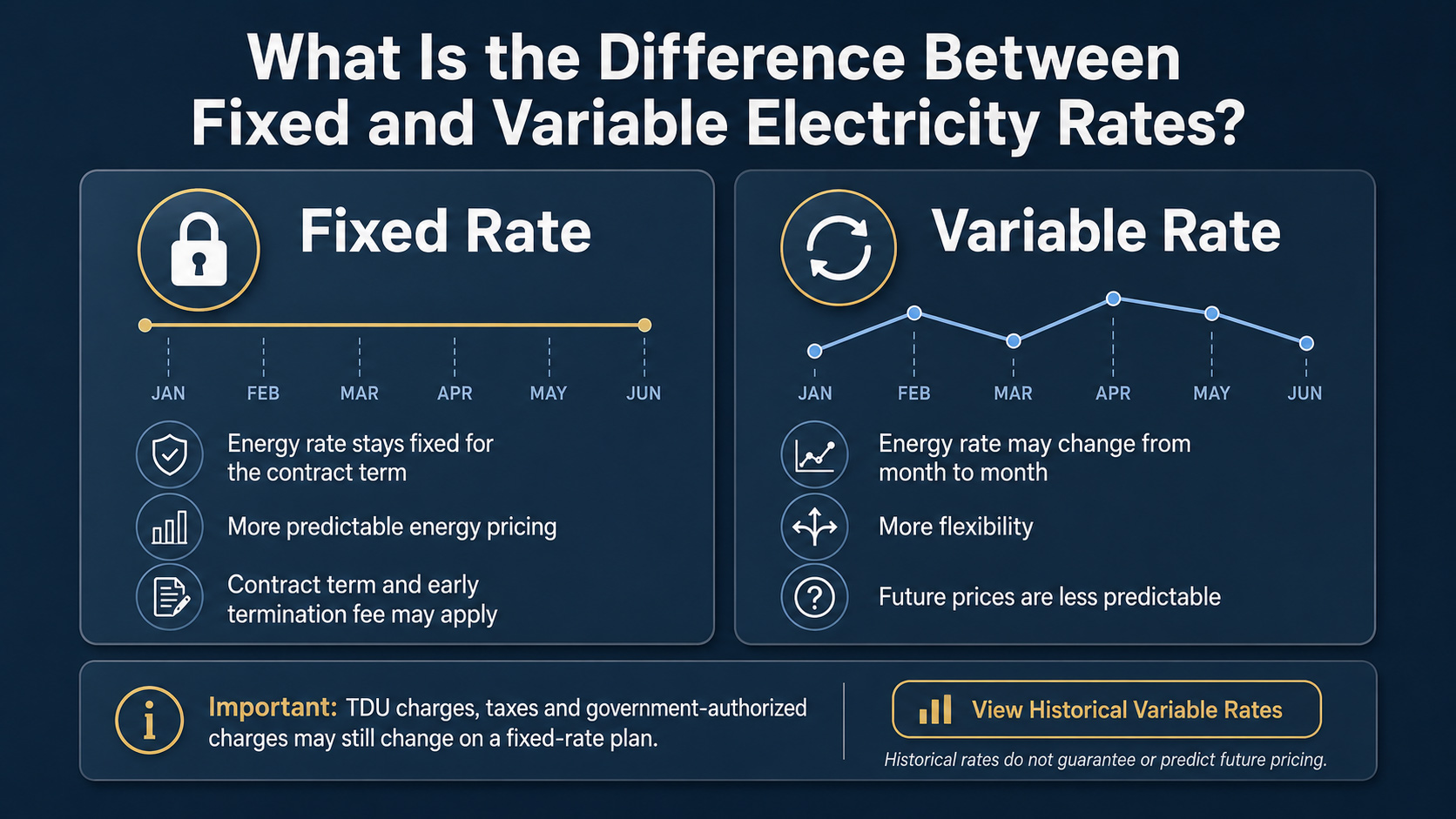
A fixed-rate plan keeps the energy rate fixed for the contract term according to the EFL and Terms of Service. TDU charges, taxes and certain government-authorized charges can still change.
A variable-rate plan has an energy charge that may change from month to month according to the plan’s terms. These plans generally provide flexibility because they do not have a long contract term, but future prices are less predictable.
Southern Federal Power publishes historical variable energy rates by utility territory. Customers can use this information to see how Southern Federal’s variable charges have changed over time. Historical rates do not guarantee or predict future pricing.
Why Does the Contract Length Matter?
Electricity contracts can end during very different market conditions from when they began. A short contract provides an earlier opportunity to shop again, while a longer contract provides a longer period under the plan’s fixed-rate terms.
Before selecting a term, consider:
- The contract end date
- Whether the customer expects to move
- The early termination fee
- The customer’s willingness to shop again soon
- Whether the contract will expire during a high-demand season
The cheapest rate today is not automatically the best overall choice if the contract ends at an inconvenient time or does not fit the customer’s plans.
What Is an Early Termination Fee?
An early termination fee, or ETF, may apply when a customer ends a fixed-term contract before its scheduled expiration date. The EFL and Terms of Service should explain the amount and conditions.
Texas customers may have protections or exceptions in certain circumstances, including some moves to a different premises. Customers should review their agreement and contact the provider before assuming a fee will or will not apply.
Do not select a long contract solely for a lower advertised rate without considering the potential cost of leaving early.
What Happens When an Electricity Contract Expires?
The Retail Electric Provider sends a contract-expiration notice before the plan ends. That notice includes information about the expiration date and available options.
If the customer does not choose a new plan or provider, service may continue on a default month-to-month product under the provider’s disclosed terms. The rate may be different from the expiring plan.
Customers should place the expiration date on their calendar and begin reviewing options before the contract ends. This helps avoid making a rushed decision or remaining on a plan they did not actively select.
Do Provider Ratings Matter?
Provider reviews and ratings can offer useful information about enrollment, billing, customer support and account management. However, ratings do not replace the EFL.
A well-reviewed provider can offer a plan that does not fit a particular usage pattern, while a competitive rate does not guarantee that every customer will have the same service experience.
Consider several forms of information:
- PUCT licensing and complaint information
- Google reviews
- Better Business Bureau information
- Trustpilot reviews
- The provider’s customer-service options
- The specific EFL and contract documents
Customers who have experience with Southern Federal Power can share an honest review on Google Reviews or Trustpilot.
Texas Electricity Shopping Checklist
Before enrolling in a Texas electricity plan:
- Confirm that the address is in a competitive electricity market.
- Identify the correct TDU territory.
- Gather up to 12 months of actual electricity usage.
- Research plans on PowerToChoose.org and provider websites.
- Open the EFL for each plan.
- Compare prices at 500, 1,000 and 2,000 kWh.
- Calculate the estimated bill at actual monthly usage.
- Identify the energy charge, base charge and TDU charges.
- Check for bill credits and minimum-usage fees.
- Review time-of-use restrictions, if applicable.
- Confirm whether the plan is fixed or variable.
- Review the contract length and expiration date.
- Check the early termination fee.
- Read the Terms of Service and Your Rights as a Customer.
- Save copies of the documents provided during enrollment.
How Do You Find the Best Texas Electricity Plan?
The best Texas electricity plan is not necessarily the one with the lowest advertised price. It is the plan that produces a competitive total cost at the household’s actual usage while providing terms, fees and features that fit the customer’s needs.
Start with usage history. Research plans through PowerToChoose.org and official provider websites. Read every EFL, calculate the complete estimated bill and understand the contract before enrolling.
Customers can visit SouthernFederal.com and enter their ZIP code and service address to review current Southern Federal Power plans available for their home.
Frequently Asked Questions
What is the best website for comparing Texas electricity plans?
PowerToChoose.org is a useful starting point because it is the official electricity-shopping website of the Public Utility Commission of Texas. Customers should also check provider websites and review the EFL for each plan.
What is the most important number on an EFL?
There is no single number that works for every customer. Compare the complete price at the household’s actual usage and review the energy charge, base charge, TDU charges, credits and fees used to calculate it.
Is the advertised electricity rate my energy charge?
Not necessarily. The advertised average price may include the energy charge, base charge, TDU charges and applicable credits. Read the EFL to see how the price is calculated.
Is a plan with no base charge always cheaper?
No. A plan without a base charge may have a higher energy charge. Compare the complete monthly cost at your expected usage rather than evaluating one fee by itself.
Why does Southern Federal Power charge a base charge?
When included in a Southern Federal Power plan, the base charge helps support fixed account-service costs such as customer care, billing systems, payment processing, communications and regulatory requirements.
Are TDU charges set by Southern Federal Power?
No. The local Transmission and Distribution Utility establishes delivery charges through the applicable regulatory process. Southern Federal Power passes the applicable charges through on the customer’s bill.
Can TDU charges change during a fixed-rate contract?
Yes. A fixed-rate plan fixes the provider’s energy rate according to the contract, but approved TDU charges, taxes and certain government-authorized charges can change.
Are bill-credit plans bad?
Not automatically. A bill-credit plan may be economical for a household that consistently meets the credit requirements. It may be costly for a customer whose usage frequently falls outside the qualifying range.
Are free-nights plans really free?
The provider’s energy charge may be free during specified hours, but TDU charges and other fees may still apply. Electricity used outside the free period may also have a higher energy rate.
Should I choose a fixed or variable plan?
That depends on the customer’s priorities. Fixed-rate plans offer greater energy-price stability during the contract term. Variable plans provide flexibility but can change from month to month.
Why should I look at 12 months of usage?
Electricity consumption changes with seasons and weather. A full year provides a better picture of how a plan may perform during both low-usage and high-usage months.
What documents should I save after enrolling?
Save the Electricity Facts Label, Terms of Service, Your Rights as a Customer document, enrollment confirmation and any promotional terms associated with the plan.