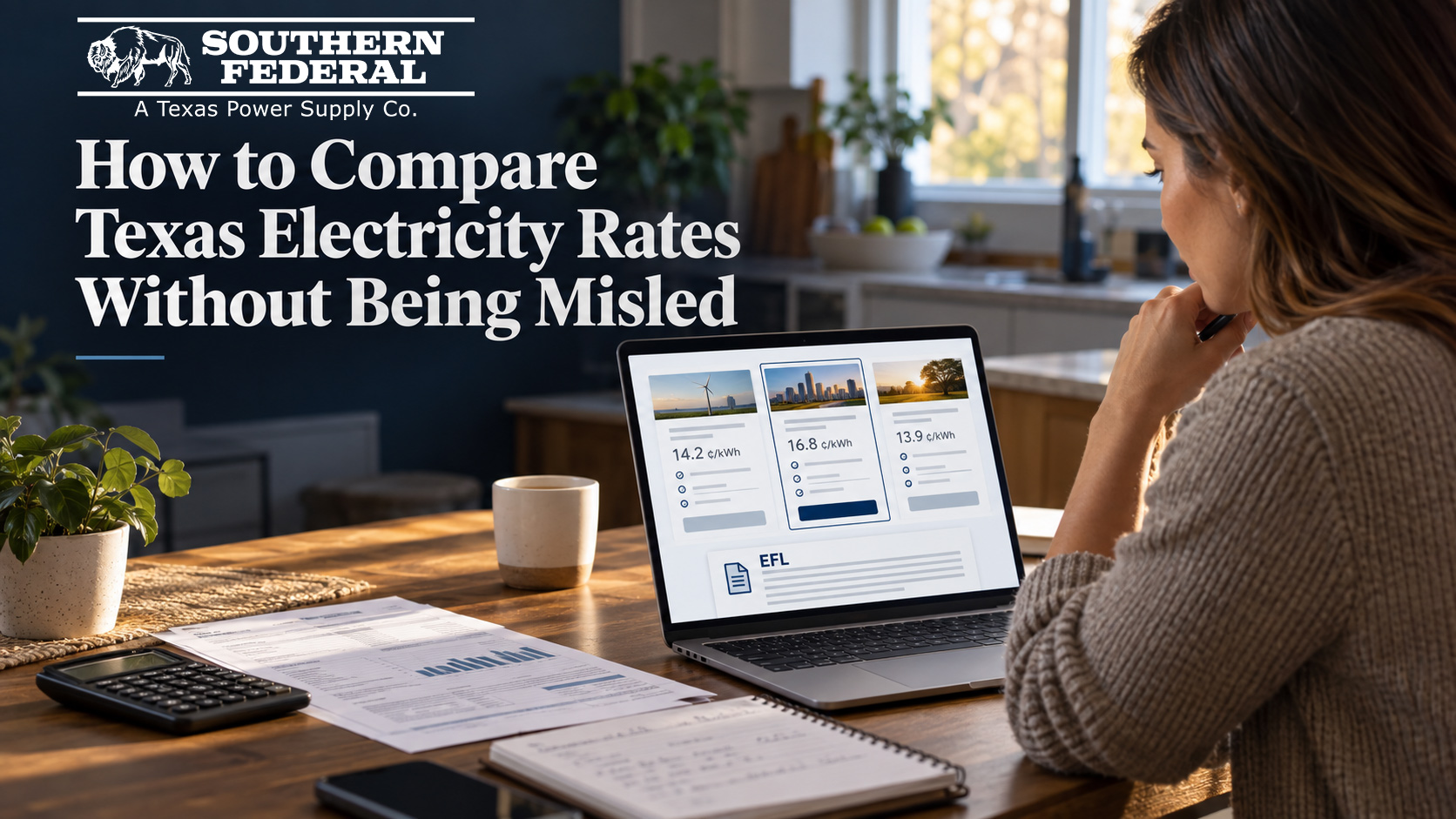
How to Compare Texas Electricity Rates Without Being Misled
Searching online for the “best electricity rates in Houston,” “lowest electricity rates in Dallas,” or similar phrases can produce dozens of comparison websites, rankings and AI-generated summaries.
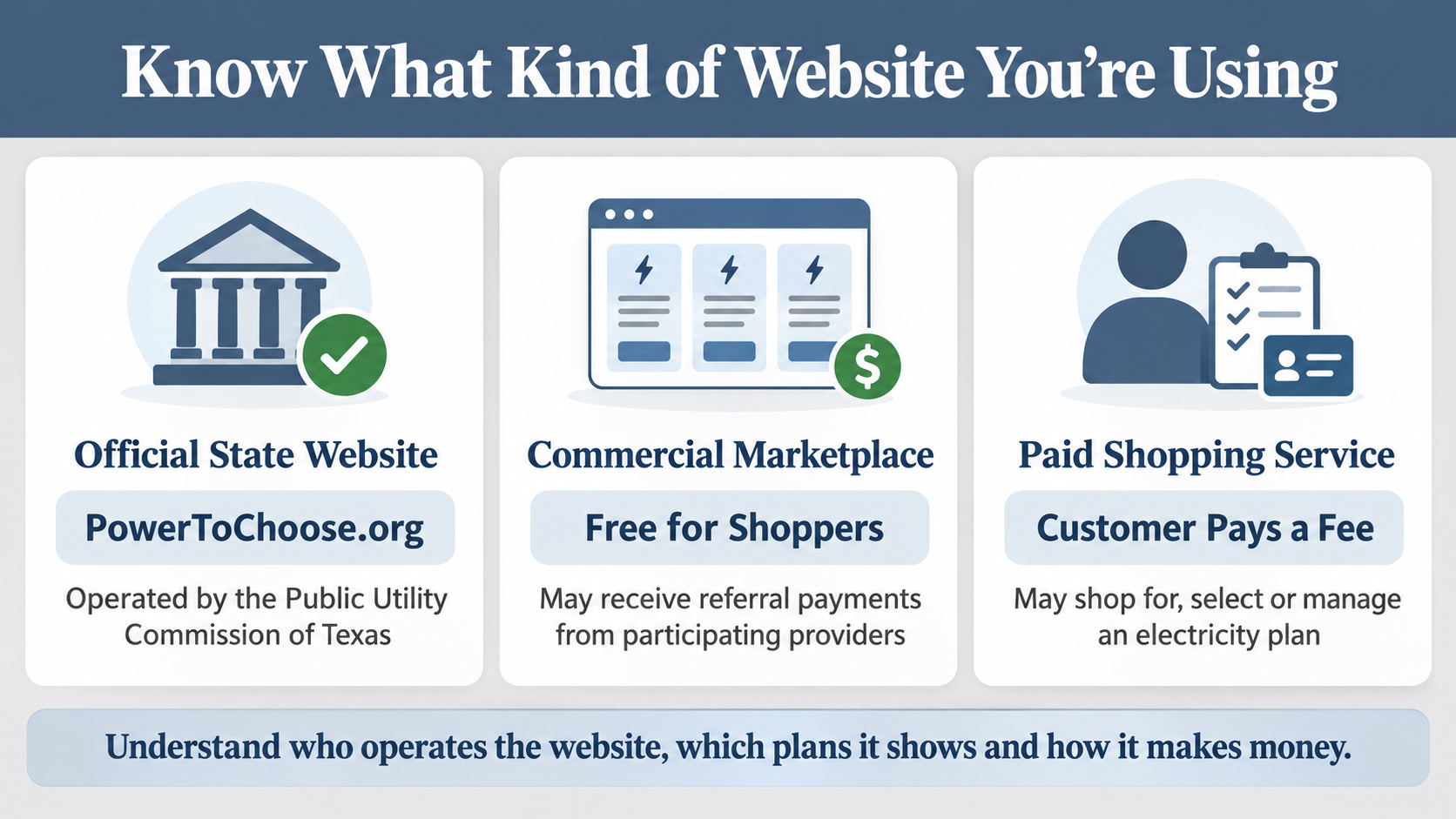
What may not be obvious is that these results can come from very different sources. Some websites are commercial marketplaces, some are registered electricity brokers, and others charge customers for shopping or account-management services.
These services may be legitimate businesses, but they are not the official Texas electricity shopping website. They may also receive compensation from participating electricity providers and may not display every plan available to you.
Before trusting a website’s “best electricity plans,” Texans should understand who operates the site, how it makes money and how its recommendations are created.
What Is the Official Texas Electricity Shopping Website?
PowerToChoose.org is the official electricity shopping website operated by the Public Utility Commission of Texas, commonly called the PUCT.
Retail Electric Providers can post qualifying electricity plans on Power to Choose for customers in competitive parts of Texas. Shoppers can enter their ZIP code, filter available offers and review the documents associated with each plan.
Power to Choose does not eliminate the need to read the plan details. It does, however, give consumers a state-operated starting point for researching electricity offers.
Customers should make sure they are visiting PowerToChoose.org. Commercial websites may use words such as “Texas,” “power,” “choice” or “electricity” in their names without being affiliated with the State of Texas or the PUCT.
Are Commercial Electricity Comparison Websites Government Websites?
Usually not.
Many commercial electricity websites are operated by private companies that provide comparison, referral, brokerage or enrollment services. Some are registered electricity brokers, but broker registration does not make a website part of the PUCT or Power to Choose.
For example, ChooseTexasPower.org states that it is operated by Save On Energy LLC and is not affiliated with PowerToChoose.org or the PUCT. Its website also says participating providers pay the company when it refers a customer who enrolls in a plan.
TexasElectricityRatings.com similarly states that it receives payment from providers when it refers customers to their electricity plans.
These disclosures do not automatically mean the information is inaccurate. They do mean the website has a commercial business model that shoppers should understand before relying on its rankings or recommendations.
Are Comparison Websites Really Free?
A commercial comparison website may be free for the customer to use, but the company still needs a way to earn revenue.
Common business models include:
- Referral payments from electricity providers
- Commissions when a customer enrolls
- Advertising arrangements
- Featured or promoted listings
- Paid membership services
- Account-management services
Energy Ogre, for example, operates as a paid membership service that shops for and enrolls members in electricity plans. That is different from a public rate board or a free commercial marketplace.
Before using any service, look for pages titled:
- How We Make Money
- Monetization Disclosure
- Advertiser Disclosure
- Terms and Conditions
- About Us
- Broker Disclosure
If the website does not clearly explain how it makes money, proceed carefully.
Does an Electricity Marketplace Show Every Available Plan?
Not necessarily.
A commercial marketplace may only display plans from providers with which it has a relationship. A provider that does not participate in the marketplace may be missing from the results, even if that provider offers service at the customer’s address.
Before assuming you have reviewed the entire market, ask:
- How many providers participate in this marketplace?
- Are nonparticipating providers included?
- Are all plans from participating providers displayed?
- Does the website receive compensation for enrollments?
- Can compensation affect which plans are highlighted?
- What method determines the order of the results?
A small disclosure at the bottom of a page may reveal that the marketplace does not represent every provider or plan.
What Does “Best Electricity Plan” Actually Mean?
Words such as “best,” “recommended,” “popular” and “top-rated” can mean different things on different websites.
A plan might be labeled “best” because it has:
- The lowest advertised average price at one usage level
- A large bill credit
- A high customer rating
- A short or long contract term
- Renewable energy content
- A promotional relationship with the website
- Features selected by the site’s editors or ranking formula
That plan may not produce the lowest bill for your household.
A recommendation is only useful when the website clearly explains its methodology and calculates the expected cost using your actual electricity consumption.
Why Can the Advertised Electricity Rate Be Misleading?
Texas Electricity Facts Labels show average prices at three usage levels:
- 500 kilowatt-hours
- 1,000 kilowatt-hours
- 2,000 kilowatt-hours
Those averages are useful comparison points, but your home may use a different amount. Some plans also include bill credits or minimum-usage conditions that make the average price look especially attractive at one particular level.
For example, a plan could appear inexpensive at exactly 1,000 kWh but become considerably more expensive at 900 or 1,100 kWh.
Never select a plan based only on the large rate displayed in an advertisement or search result.
What Should I Look for in the Electricity Facts Label?
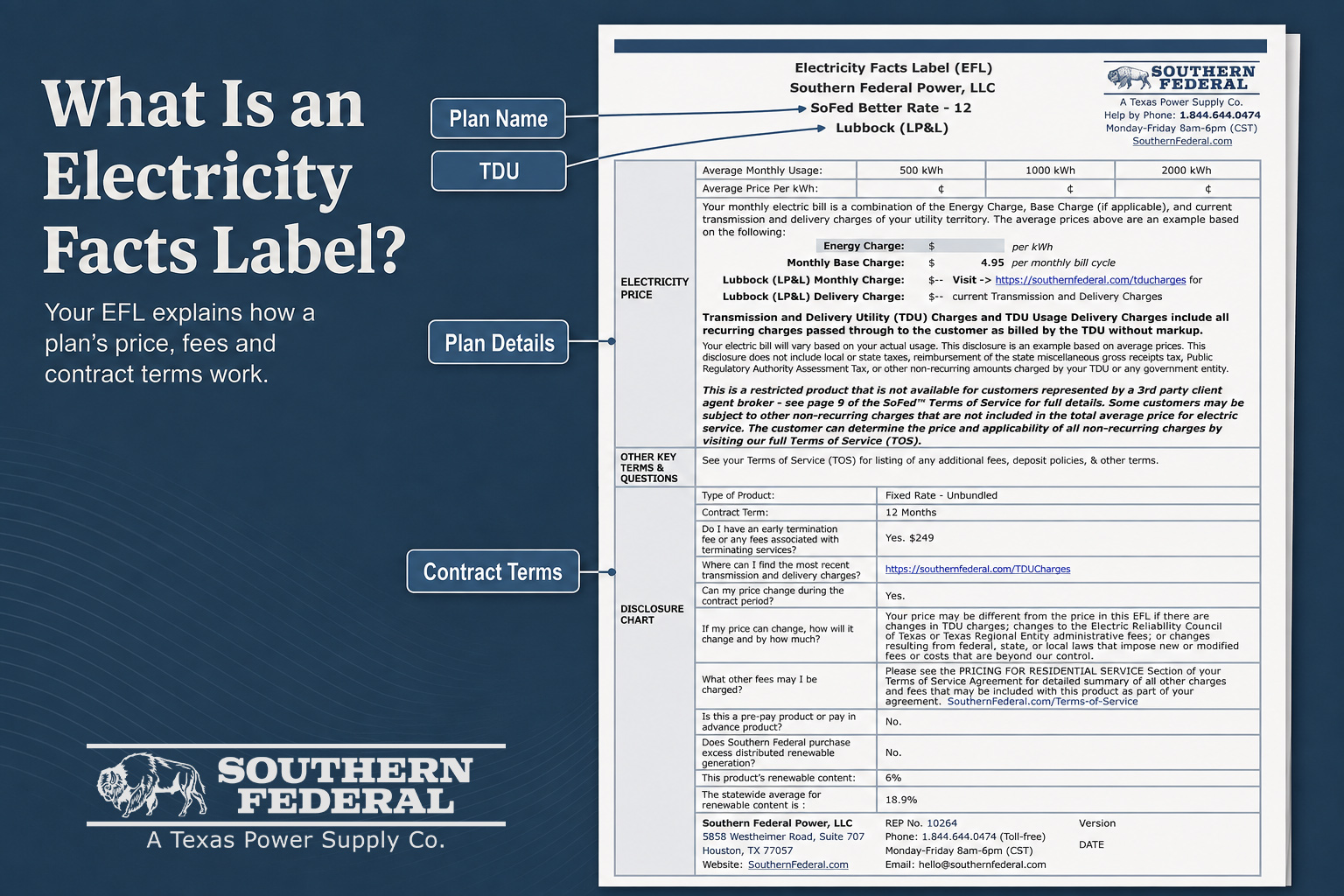
The Electricity Facts Label, or EFL, is the standardized disclosure document for a Texas electricity plan. It provides more meaningful information than a “best plan” badge.
Review the EFL for:
- Energy charge per kilowatt-hour
- Monthly provider base charge
- Fixed TDU charge
- Usage-based TDU delivery charge
- Bill credits and their qualifying usage ranges
- Minimum-usage charges
- Contract length
- Early termination fee
- Fixed-rate or variable-rate status
- Renewable energy content
- Other recurring charges
You should also read the Terms of Service and Your Rights as a Customer document before enrolling.
Can I Trust an AI Overview of Texas Electricity Rates?
AI-generated summaries can be useful for finding topics to research, but they should not be treated as electricity quotes.
An AI answer may:
- Pull information from commercial marketplaces
- Combine rates from different utility territories
- Use prices collected on different dates
- Feature only selected providers
- Confuse the energy charge with the average all-in price
- Miss base charges, delivery fees or bill-credit requirements
- Display an outdated offer
Electricity rates change frequently and depend on the service address. Always verify a quoted rate using the current EFL for the exact plan and utility territory.
A Checklist for Comparing Texas Electricity Plans
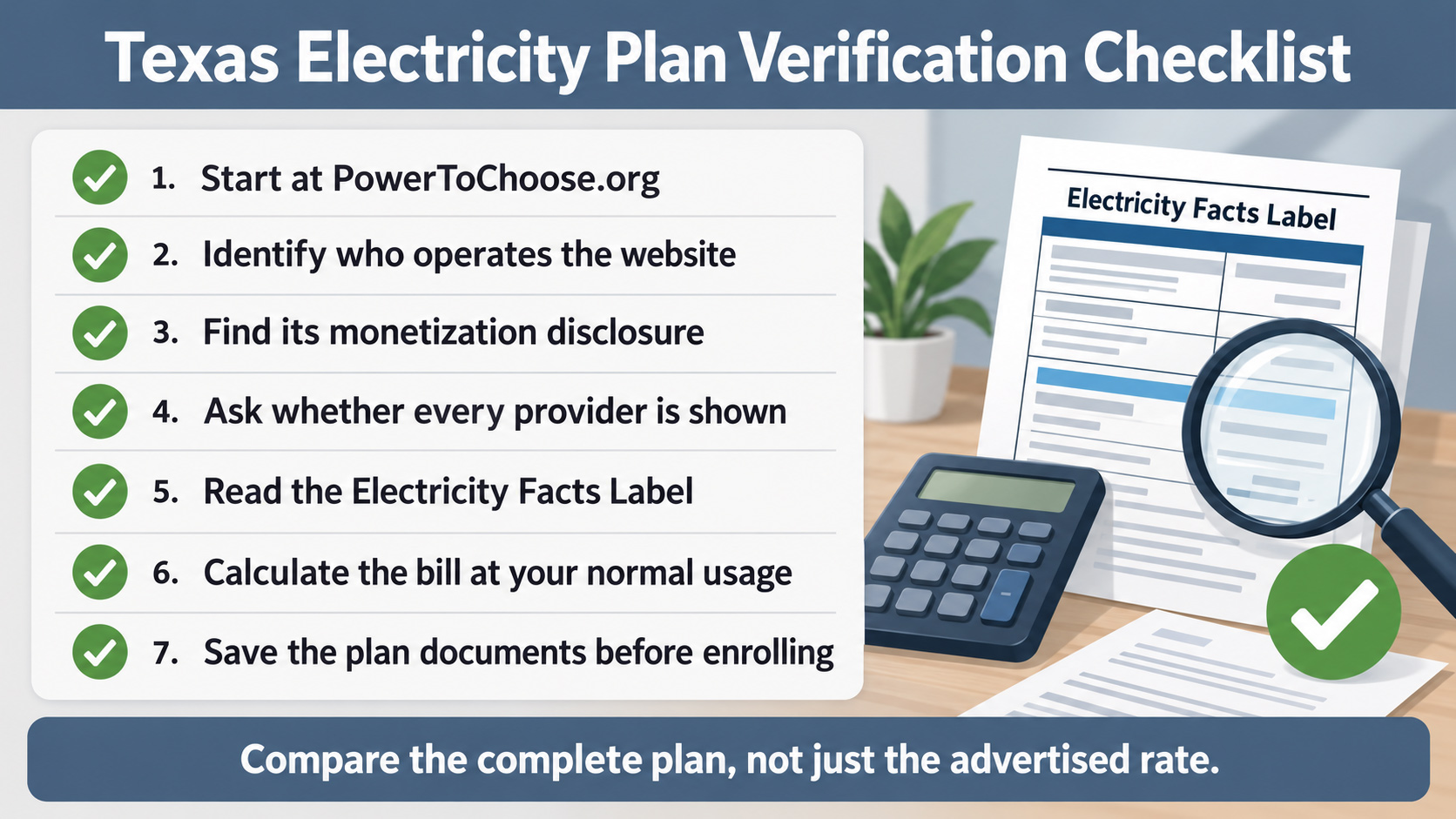
Before enrolling, take these steps:
- Start your research at PowerToChoose.org.
- Enter the ZIP code for the service address.
- Identify the local Transmission and Distribution Utility.
- Review more than the first few search results.
- Download the EFL for every plan you are seriously considering.
- Calculate the estimated bill at your normal usage.
- Check whether bill credits require a specific usage range.
- Include all provider and TDU charges in your calculation.
- Review the contract term and early termination fee.
- Compare the offer with the provider’s official website.
- Investigate how any comparison website makes money.
- Save copies of the plan documents before enrolling.
Should I Avoid Every Commercial Comparison Website?
Not necessarily.
Some customers value the convenience of a commercial marketplace, broker or shopping service. These businesses may offer useful filters, calculators, recommendations or enrollment assistance.
The important thing is to recognize what you are using.
A commercial comparison site is not the same as the official Power to Choose website. Its results may reflect a limited group of providers, and the company may receive compensation when customers enroll.
Use commercial recommendations as one source of information, not as proof that you have seen every available option.
The Bottom Line
PowerToChoose.org is the official electricity shopping website operated by the Public Utility Commission of Texas. It should be one of the first places Texans visit when researching electricity plans.
Commercial electricity websites can provide convenient tools, but customers should determine:
- Who operates the website
- Whether it is affiliated with the PUCT
- How it earns money
- Which providers it represents
- Whether its rankings include every available plan
- How it defines the word “best”
The most important document is not a ranking, advertisement or AI-generated summary. It is the Electricity Facts Label for the specific plan you are considering.
Compare the market, read the EFL and calculate the expected bill using your household’s actual electricity consumption. An informed customer is in a much better position to choose an electricity plan that fits their needs.
Frequently Asked Questions
Is PowerToChoose.org a government website?
Yes. PowerToChoose.org is operated by the Public Utility Commission of Texas and is the state’s official electricity shopping website.
Are Texas electricity comparison websites regulated?
Some comparison services operate through registered electricity brokers. Registration does not mean the website is operated by or affiliated with the PUCT.
Do electricity providers pay comparison websites?
Some commercial marketplaces disclose that participating providers compensate them for customer referrals or enrollments. Check each website’s monetization and advertiser disclosures.
Does the lowest advertised rate guarantee the lowest bill?
No. Your complete bill can include energy charges, provider base charges, TDU charges and other plan-specific costs. Bill credits can also cause the effective rate to change at different usage levels.
Where can I find the complete terms of an electricity plan?
Review the plan’s Electricity Facts Label, Terms of Service and Your Rights as a Customer document before enrolling.
Can Southern Federal Power help explain its plan documents?
Yes. Southern Federal Power customers and prospective customers can contact our U.S.-based customer service team with questions about Southern Federal plans, charges and contract terms. Spanish-speaking assistance is also available.
Commercial website disclosures and business models can change. The examples in this article are based on information published by the respective companies at the time of writing. This article is provided for general consumer education and should be reviewed by legal counsel before publication.